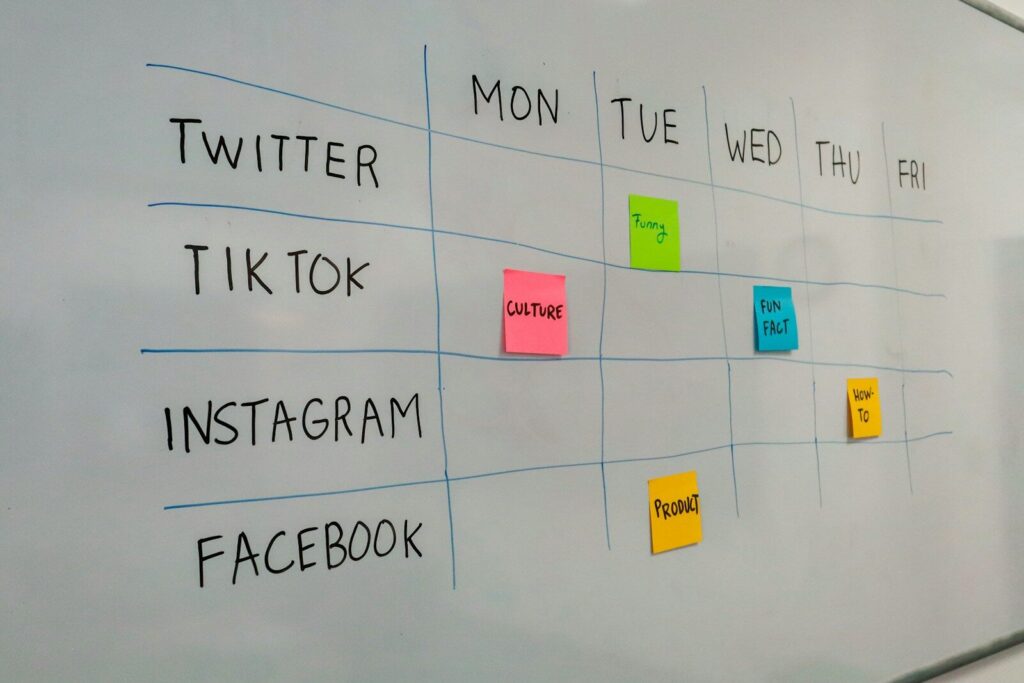
Social media success rarely comes from posting more content. It comes from publishing the right types of social media content for the right audience at the right stage of the customer journey. Businesses that understand content formats consistently generate stronger engagement, higher reach, and better conversion rates than competitors that post randomly.
Many brands struggle because they focus on content creation instead of content strategy. A structured approach helps you choose formats that support awareness, engagement, lead generation, and sales while building a repeatable system. If you want a broader framework, start with our Social Media Marketing Strategies pillar guide, which explains how content fits into an overall social media growth engine.
The reality is simple. Different content formats serve different business objectives. Understanding those differences allows you to create content that performs instead of content that simply fills a calendar.
Quick Summary
The most effective types of social media content include short-form videos, carousel posts, interactive content, user-generated content, educational posts, thought leadership, customer stories, product demonstrations, live content, industry commentary, behind-the-scenes content, and trend-based content. Businesses that align content formats with specific goals typically achieve stronger engagement, better audience retention, and higher conversion rates.
The Current State of Social Media Content
Why Authentic Content Is Winning
Authentic content consistently outperforms overly polished content across most major social platforms.
Users spend hours every day consuming content from creators rather than brands. As a result, audiences increasingly trust content that feels genuine, practical, and experience-driven rather than heavily produced marketing assets.
Platforms such as Instagram, LinkedIn, TikTok, Facebook, and YouTube reward engagement signals. Therefore, content that generates conversations, saves, shares, and watch time often receives stronger organic distribution.
Many businesses assume expensive production creates better performance. However, creator-style content often generates higher engagement because audiences perceive it as more trustworthy and relatable.
Why Content Format Matters More Than Posting Frequency
Modern social media strategies prioritize performance metrics over publishing volume.
Many organizations previously measured success through post counts. Today, successful brands focus on engagement rates, watch time, saves, click-through rates, and conversions.
This shift changes content planning significantly. Instead of asking “What should we post today?” marketers ask “What content format best supports our objective?”
That single change improves content quality, strategic alignment, and return on investment.
The Content-to-Goal Matrix
Different types of social media content support different marketing objectives.
| Content Type | Brand Awareness | Engagement | Conversions |
|---|---|---|---|
| Short-Form Video | High | High | Medium |
| Carousel Posts | Medium | High | Medium |
| Interactive Content | Medium | High | Low |
| User-Generated Content | Medium | Medium | High |
| Educational Content | Medium | High | High |
| Behind-the-Scenes Content | Medium | Medium | Low |
| Thought Leadership | High | Medium | High |
| Customer Success Stories | Medium | Medium | High |
| Product Demonstrations | Low | Medium | High |
| Live Content | Medium | High | Medium |
| Industry Commentary | High | Medium | Medium |
| Trend-Based Content | High | High | Low |
The 12 Essential Types of Social Media Content
Short-Form Video: The Engagement King
Short-form video remains one of the highest-performing types of social media content for attention and engagement.
Platforms such as TikTok, Instagram Reels, Facebook Reels, and YouTube Shorts prioritize video content because it keeps users active on the platform longer. As a result, short-form videos often receive stronger organic reach than static formats.
The most effective videos focus on a single message. They quickly communicate value and encourage viewers to watch until the end.
Popular short-form video formats include:
- Quick tutorials
- Industry tips
- Product demonstrations
- Customer stories
- Behind-the-scenes clips
- Myth-busting content
One observation I consistently see across client campaigns is that authenticity matters more than production quality. Videos recorded with a smartphone frequently outperform highly produced promotional videos because they feel more human and trustworthy.
Carousels: The Education Workhorse
Carousel posts are among the best content formats for delivering educational value.
Carousels encourage users to spend more time interacting with content. Every swipe signals engagement, which often improves content visibility and distribution.
Unlike single-image posts, carousels allow businesses to explain concepts step by step. Therefore, they work exceptionally well for educational content marketing.
Strong carousel topics include:
- Frameworks
- Checklists
- Case studies
- Statistics breakdowns
- Process explanations
- Before-and-after transformations
Many marketers focus only on likes. However, carousel success often comes from saves and shares, which are stronger indicators of long-term content value.
Interactive Content: Polls, Quizzes, and Q&As
Interactive content transforms passive audiences into active participants.
Most content asks users to consume information. Interactive content asks users to contribute. This shift increases engagement while simultaneously providing valuable audience insights.
Interactive content formats include:
- Polls
- Quizzes
- Ask-me-anything sessions
- Question stickers
- Surveys
- Community discussions
Businesses frequently underestimate the strategic value of polls. Every response provides first-party audience data that can improve future content, products, and campaigns.
User-Generated Content (UGC) and Social Proof
User-generated content builds trust faster than traditional brand messaging.
Consumers generally trust recommendations from other customers more than promotional messages from businesses. Therefore, user-generated content plays a critical role in modern social media marketing.
Examples of UGC include:
- Customer reviews
- Product photos
- Testimonials
- Customer videos
- Community posts
- Success stories
A simple UGC acquisition framework works well:
- Ask customers to share experiences.
- Provide simple participation instructions.
- Highlight community contributions publicly.
- Repurpose the best content across channels.
This approach creates a sustainable content source while strengthening customer relationships.
Educational Content
Educational content positions businesses as trusted industry resources.
Many users visit social media platforms to learn new skills, solve problems, or improve performance. Educational content addresses those needs directly.
Effective educational content formats include:
- Tutorials
- Guides
- How-to posts
- Industry frameworks
- Tips and tricks
- Common mistakes
Businesses often focus exclusively on selling. However, teaching typically creates stronger long-term trust and higher conversion rates.
Need a Social Media Content Strategy That Actually Generates Leads?
Most businesses create content consistently but still struggle with reach, engagement, and conversions. The issue is usually strategy, not effort.
Behind-the-Scenes Content
Behind-the-scenes content humanizes brands and builds stronger audience connections.
People naturally connect with people rather than logos. Showing internal processes, team members, workflows, and company culture helps create familiarity and trust.
Popular behind-the-scenes content includes:
- Team introductions
- Production processes
- Office culture
- Project development
- Event preparation
- Daily operations
Many organizations hide their processes. However, transparency often becomes a competitive advantage because audiences appreciate authenticity.
Thought Leadership Content
Thought leadership content helps businesses establish authority within their industry.
Instead of simply sharing information, thought leadership adds perspective, analysis, and expertise. This distinction makes it particularly valuable for consultants, agencies, founders, executives, and B2B companies.
Strong thought leadership topics include:
- Industry predictions
- Strategic insights
- Original frameworks
- Market observations
- Lessons learned
- Contrarian viewpoints
The most effective thought leadership content is based on real-world implementation experience rather than theory. Readers quickly recognize the difference.
Customer Success Stories
Customer success stories transform customer outcomes into persuasive marketing assets.
Most prospects want proof before making a purchase decision. Customer stories provide that proof by showing real results achieved by real people using a product or service.
Effective customer success content includes:
- Before-and-after scenarios
- Revenue growth examples
- Time savings
- Process improvements
- Customer testimonials
- Business transformation stories
The strongest customer stories focus on outcomes rather than features. Audiences care more about results than product specifications.
What Makes Customer Stories Effective?
Customer stories reduce uncertainty during the buying process.
When prospects see similar businesses achieving positive results, they become more confident in their purchasing decisions. Therefore, customer stories often contribute directly to lead generation and conversions.
A simple framework works well:
- Initial challenge
- Solution implementation
- Measurable results
- Key lessons learned
This structure keeps stories clear, practical, and credible.
Product Demonstrations
Product demonstrations help audiences understand how products solve specific problems.
Many businesses talk extensively about features without showing practical applications. Product demonstrations bridge that gap by visually connecting features to outcomes.
Popular product demonstration formats include:
- Screen recordings
- Product walkthroughs
- Feature showcases
- Live demonstrations
- Side-by-side comparisons
- Problem-solving tutorials
Software companies often use demonstration content to accelerate buying decisions. However, product demonstrations work equally well for service businesses, ecommerce brands, and consultants.
How to Create Better Product Demonstrations
The best product demonstrations focus on outcomes rather than functionality.
Instead of explaining every feature, show how users accomplish a specific goal. This approach keeps attention high while making the value proposition easier to understand.
For example, a CRM demonstration should focus on increasing sales efficiency rather than listing every available dashboard.
Live Content
Live content creates real-time engagement opportunities that recorded content cannot replicate.
Audiences appreciate live interactions because they provide immediate access, authentic conversations, and unfiltered expertise. As a result, live sessions often generate high engagement rates.
Popular live content formats include:
- Webinars
- Live Q&A sessions
- Product launches
- Expert interviews
- Industry discussions
- Community events
Unlike pre-recorded content, live sessions encourage direct audience participation. Therefore, they often generate valuable insights and stronger community relationships.
When Should Businesses Use Live Content?
Live content works best when audience interaction is the primary objective.
Businesses should use live sessions when introducing new products, answering common questions, gathering audience feedback, or building community engagement.
Consistency matters more than frequency. A monthly high-value live session often outperforms weekly low-quality broadcasts.
Industry News and Commentary
Industry commentary helps brands remain relevant and visible within ongoing conversations.
Every industry experiences changes, trends, challenges, and innovations. Businesses that provide thoughtful analysis position themselves as informed market participants.
Examples include:
- Algorithm updates
- Market shifts
- Regulatory changes
- Technology developments
- Consumer behavior trends
- Industry reports
Many organizations simply repost news. However, adding expert interpretation creates significantly more value for audiences.
The Difference Between Reporting and Commentary
Commentary adds perspective while reporting only shares information.
A simple news article tells audiences what happened. Strong commentary explains why it matters and how businesses should respond.
This distinction separates industry leaders from content aggregators.
Trend-Based and Entertainment Content
Trend-based content helps brands expand reach by participating in popular conversations.
Social media platforms reward content that aligns with current user interests. Therefore, relevant trend participation can increase visibility and audience growth.
Examples include:
- Trending audio
- Viral formats
- Popular challenges
- Cultural moments
- Industry memes
- Timely events
However, not every trend fits every brand. Strategic alignment remains essential.
How to Use Trends Without Looking Forced
Trend participation should support brand positioning rather than distract from it.
Businesses should evaluate every trend using three questions:
- Is it relevant to our audience?
- Does it align with our brand?
- Can we add meaningful value?
If the answer is no, skip the trend and focus on evergreen content.
Content Strategy Framework
Struggling to Decide What Content to Publish? Many businesses create content consistently but still fail to generate meaningful results because every format serves a different purpose.
Mapping Content Types to Your Business Goals
Content Types for Brand Awareness
Brand awareness campaigns require formats that maximize reach and discoverability.
The most effective formats include:
- Short-form video
- Thought leadership
- Industry commentary
- Trend-based content
These formats help businesses reach audiences beyond their existing followers.
Content Types for Engagement
Engagement-focused content encourages interaction and community participation.
Strong engagement formats include:
- Carousel posts
- Interactive content
- Live sessions
- Short-form videos
These formats generate comments, shares, saves, and conversations.
Content Types for Lead Generation
Lead generation content focuses on trust, expertise, and problem-solving.
Recommended formats include:
- Educational content
- Customer success stories
- Thought leadership
- Product demonstrations
These formats move prospects closer to purchase decisions.
Content Types for Sales and Conversion
Conversion-focused content reduces uncertainty and supports purchasing decisions.
The highest-performing formats include:
- Customer stories
- Product demonstrations
- User-generated content
- Educational content
These formats provide proof and clarity during evaluation stages.
Content Types for Customer Retention
Customer retention requires ongoing value beyond the initial purchase.
Effective retention formats include:
- Educational content
- Community content
- Live sessions
- Customer spotlights
Consistent value keeps audiences engaged long after becoming customers.
What Should I Post? Decision Framework
The best content format depends entirely on the desired business outcome.
| Goal | Recommended Content Type |
|---|---|
| Increase Reach | Short-Form Video, Trends, Commentary |
| Increase Engagement | Carousels, Polls, Q&A Sessions |
| Generate Leads | Educational Content, Case Studies |
| Build Trust | UGC, Testimonials, Customer Stories |
| Increase Sales | Demonstrations, Success Stories |
| Improve Retention | Educational and Community Content |
How to Measure and Optimize Social Media Content
Step 1: Tag Every Content Format
Performance measurement starts with proper content categorization.
Many businesses cannot identify winning formats because they never track content by category. Every post should be tagged according to its format.
Track metrics such as:
- Reach
- Impressions
- Engagement rate
- Saves
- Shares
- Click-through rate
- Leads
- Conversions
This approach creates clear visibility into content performance.
Step 2: Analyze Performance Trends
Content optimization requires pattern recognition rather than isolated analysis.
Individual posts can produce misleading results. Therefore, evaluate performance across multiple posts within the same category.
Useful analytics platforms include:
- Meta Business Suite
- LinkedIn Analytics
- Google Analytics
- Buffer
- Hootsuite
- Sprout Social
Consistent tracking reveals which formats generate the strongest business outcomes.
Step 3: Iterate Based on Data
Optimization means expanding winners and improving underperformers.
A simple content evaluation framework works effectively:
Keep
Formats that consistently exceed benchmarks.
Improve
Formats that show potential but require refinement.
Replace
Formats that repeatedly underperform.
This framework prevents emotional decision-making and supports data-driven growth.
The Social Media Content Lifecycle
High-performing content follows a repeatable operational system.
Ideation → Creation → Distribution → Measurement → Repurposing
Many businesses stop after publishing. However, repurposing often generates additional value with minimal effort.
For example:
- Videos become carousels
- Webinars become clips
- Blog posts become LinkedIn content
- Case studies become customer stories
This process increases content efficiency while maximizing return on investment.
Common Social Media Content Mistakes
Posting Without Defined Objectives
Content without goals usually produces inconsistent results.
Every piece of content should support awareness, engagement, lead generation, conversion, or retention.
Without a defined objective, performance becomes difficult to measure.
Chasing Every Trend
Not every trend deserves participation.
Brands frequently dilute positioning by following irrelevant trends. Strategic consistency typically delivers stronger long-term outcomes.
Ignoring Analytics
Content decisions should rely on data rather than assumptions.
Analytics reveal what audiences actually value. Therefore, regular performance reviews should become part of every content workflow.
Over-Promoting Products
Constant promotion often reduces engagement and trust.
Audiences follow brands for value, education, entertainment, and insights. Excessive promotional content discourages long-term engagement.
Failing to Repurpose Content
Repurposing increases content output without increasing production effort.
Many businesses create valuable content once and never use it again. Repurposing solves this inefficiency.
Publishing Identical Content Everywhere
Each platform has unique audience behaviors and expectations.
A LinkedIn audience consumes content differently than a TikTok audience. Therefore, platform-specific adaptation often improves performance.
Strategic Content Alignment
Content Is Not the Problem. Strategy Usually Is.
If your business is publishing consistently but seeing little growth, the issue is often format selection, messaging, and distribution strategy.
Frequently Asked Questions
Which type of social media content gets the most engagement?
Short-form video typically generates the highest engagement across major social platforms. It benefits from strong algorithmic support, high watch time potential, and broad audience appeal.
What content works best for B2B social media marketing?
Educational content, thought leadership, customer stories, and industry commentary usually perform best for B2B audiences. These formats build authority while supporting lead generation and trust development.
How often should businesses publish different content types?
Publishing frequency should depend on quality and resources rather than arbitrary schedules. Consistent delivery of valuable content typically outperforms high-volume publishing.
What is the ideal social media content mix?
Most businesses benefit from balancing educational, engagement-focused, trust-building, and conversion-oriented content. A diversified content portfolio supports multiple business objectives simultaneously.
How can I encourage customers to create user-generated content?
Businesses should actively request customer participation and make contribution simple. Recognition, incentives, and community visibility often increase participation rates.
Which social media content drives the most conversions?
Customer success stories, product demonstrations, educational content, and user-generated content typically drive the strongest conversion performance. These formats reduce uncertainty during purchasing decisions.
Can I repurpose the same content across multiple social platforms?
Yes, but each platform should receive optimized versions rather than identical copies. Platform-specific formatting and audience expectations significantly influence performance.
The Bottom Line on Types of Social Media Content
The most effective types of social media content are the formats that align directly with specific business objectives.
Businesses that treat all content formats equally often struggle with inconsistent performance. In contrast, organizations that intentionally match content types to awareness, engagement, lead generation, and conversion goals create more predictable growth systems.
Execution Roadmap
Week 1: Audit Existing Content
- Categorize current content
- Identify top performers
- Review engagement metrics
Week 2: Build Content Pillars
- Define key themes
- Align topics with business goals
- Create a content framework
Week 3: Test Multiple Formats
- Publish across several content categories
- Measure performance consistently
- Collect audience feedback
Week 4: Optimize and Scale
- Double down on winning formats
- Repurpose high-performing assets
- Improve underperforming content
Expert Observation From Shihab Shovon
One pattern I repeatedly see across business, SaaS, and service-based brands is that content failure rarely comes from poor design or limited budgets. Most failures happen because businesses choose content formats randomly without connecting them to measurable objectives.
A format-first strategy creates clarity. When every content type serves a defined purpose, social media becomes a growth system rather than a publishing activity.